

History of Pixels.
The term pixel art was first published by Adele Goldberg and Robert Flegal of Xerox Palo Alto Research Center in 1982. The concept, however, goes back about 10 years before that, for example in Richard Shoup's SuperPaint system in 1972, also at Xerox PARC.
Some traditional art forms, such as cross-stitch, mosaic and beadwork, bear some similarity to pixel art by constructing pictures out of small colored units analogous to the pixels of modern digital computing. A similar concept on a much bigger scale can be seen in the mass games.
In digital imaging, a pixel (picture element) is the smallest piece of information in an image. Pixels are normally arranged in a regular 2-dimensional grid, and are often represented using dots, squares, or rectangles. Each pixel is a sample of an original image, where more samples typically provide a more accurate representation of the original. The intensity of each pixel is variable; in color systems, each pixel has typically three or four components such as red, green, and blue, or cyan, magenta, yellow, and black.
The word pixel is based on a contraction of pix (for "pictures") and el (for "element"); similar formations with el for "element" include voxel, luxel, and texel.
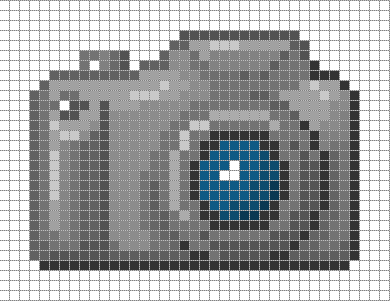
Examples of pixels : -


The term pixel art was first published by Adele Goldberg and Robert Flegal of Xerox Palo Alto Research Center in 1982. The concept, however, goes back about 10 years before that, for example in Richard Shoup's SuperPaint system in 1972, also at Xerox PARC.
Some traditional art forms, such as cross-stitch, mosaic and beadwork, bear some similarity to pixel art by constructing pictures out of small colored units analogous to the pixels of modern digital computing. A similar concept on a much bigger scale can be seen in the mass games.
In digital imaging, a pixel (picture element) is the smallest piece of information in an image. Pixels are normally arranged in a regular 2-dimensional grid, and are often represented using dots, squares, or rectangles. Each pixel is a sample of an original image, where more samples typically provide a more accurate representation of the original. The intensity of each pixel is variable; in color systems, each pixel has typically three or four components such as red, green, and blue, or cyan, magenta, yellow, and black.
The word pixel is based on a contraction of pix (for "pictures") and el (for "element"); similar formations with el for "element" include voxel, luxel, and texel.
Examples of pixels : -


No comments:
Post a Comment